
Choosing between a marquise, oval, or pear diamond for an engagement ring can feel like an impossible decision. Each cut offers a distinct personality, a different way of catching light, and a unique silhouette on the hand. This guide moves beyond surface-level preferences to give you a side-by-side evaluation of cost, durability, setting compatibility, and resale value. Drawing on the Gemological Institute of America’s Fall 2024 research paper on fancy-shaped diamonds, we will break down exactly what to expect from each elongated cut so you can walk into a jewelry store in 2026 with total confidence.
Table of Contents
Understanding the Three Elongated Diamond Cuts
The marquise diamond features a distinctive football or boat-shaped silhouette with two pointed ends, maximizing horizontal spread across the finger. The oval diamond is a perfectly symmetrical elongated circle, offering a softer, more continuous outline. The pear diamond, often called a teardrop, combines a rounded top with a single pointed tip, blending the softness of a round cut with the directional pull of a marquise. The GIA recognizes over 40 distinct categories of fancy-shaped diamonds, yet these three remain among the most requested for engagement rings precisely because of their elongation advantage. All three shapes create the illusion of longer, slimmer fingers compared to a standard round brilliant cut. They also share a common optical characteristic known as the bow-tie effect, a dark shadow pattern that runs across the center of the stone. The length-to-width ratio ranges differ for each: oval typically falls between 1.2 and 1.7, pear between 1.3 and 1.8, and marquise stretches the furthest at 1.5 to 2.5.

Side-by-Side Comparison: Marquise vs. Oval vs. Pear
Visual Impact and Finger Coverage
The marquise cut is the undisputed champion of spread per carat. Its long, pointed geometry means a one-carat marquise can look significantly larger than a one-carat round or even an oval, making it an attractive choice for buyers prioritizing visual presence. The oval offers balanced elongation with softer edges, creating a classic, versatile look that flatters a wide range of hand shapes without overwhelming shorter fingers. The pear diamond directs the eye along the finger, with the rounded top drawing attention and the pointed tip extending the visual line. Real-world feedback from communities like Reddit’s r/EngagementRings consistently notes that pear and marquise shapes “really popped” on actual hands compared to oval, which some users found blended in more subtly. All three shapes outperform round brilliant cuts in perceived size per carat, giving you more visual impact for your budget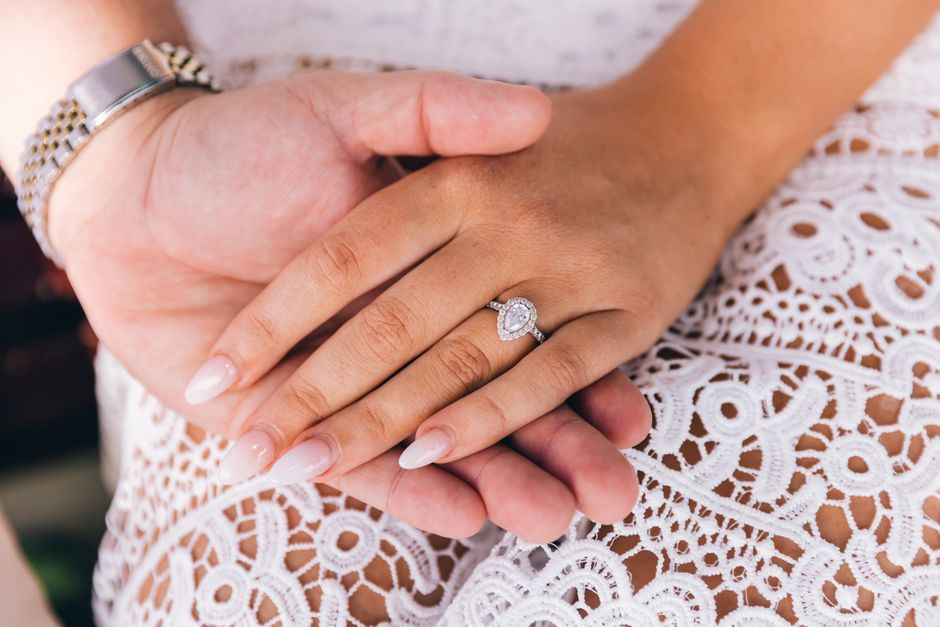
The Bow-Tie Effect: What to Expect
The bow-tie effect is a shadow pattern caused by light leakage across the center of elongated diamonds, and it varies in prominence by shape. GIA’s Fall 2024 research, published in Volume 60, Number 3 of their professional journal, confirms that the bow-tie is most prominent in marquise cuts, followed by pear, with oval showing the least. The study also revealed that observers “consistently disliked diamonds with prominent windowing” but expressed a “broader range of opinions regarding the ‘bow tie’ and ‘crushed ice’ patterns.” This means a slight bow-tie is not automatically a flaw. Some wearers find it adds depth and character, while others prefer a stone that minimizes it. The practical takeaway is to view any elongated diamond in multiple lighting conditions before purchasing. Overhead jewelry store lights can mask or exaggerate the effect, so ask to see the stone near a window or in natural daylight. Higher-quality cuts with precise facet alignment will minimize the bow-tie, and regional preferences noted by GIA suggest that some markets actively prefer a subtle bow-tie as a mark of authenticity in the cut.
Durability and Wearability
This is a critical consideration that many comparison guides overlook. The pointed tips on marquise and pear diamonds are vulnerable to chipping, especially if the ring is worn during physical activity. A marquise has two exposed points, doubling the risk, while a pear has one point at the tip. Oval diamonds, with their continuous curved edge, are significantly more durable and less likely to snag on clothing or suffer impact damage. The setting you choose directly affects long-term wearability. V-prongs or bezel settings can fully protect the vulnerable points on marquise and pear cuts, while a standard four or six-prong setting works securely for an oval. If your daily routine involves hands-on work, sports, or frequent use of your hands, an oval in a low-profile setting may be the most practical choice. For a marquise or pear, a protective bezel or halo setting is not just a style preference, it is a functional necessity for a ring meant to last a lifetime.
Cost Comparison: Which Cut Offers the Best Value in 2026?
Marquise diamonds typically command a premium of 15 to 25 percent more per carat than pear diamonds at equivalent quality, driven by perceived rarity and the dramatic spread the cut provides. Pear is generally the most affordable of the three elongated shapes, described in industry buyer guides as more commonplace, though this does not diminish its elegance. Oval diamonds sit between pear and marquise in pricing, with strong and steady demand keeping values stable. For a one-carat stone with SI1 clarity and G-H color, a common benchmark for engagement rings, you can expect pear diamonds to start around $2,800 to $3,500, ovals from $3,200 to $4,200, and marquise cuts from $3,800 to $5,000 depending on cut quality and certification. Mixed-shape designs offer another path to value. A Kay Outlet ring combining oval, pear, marquise, and round diamonds with a total weight of three-quarters of a carat retails for $1,899.99, demonstrating how incorporating multiple shapes can create visual complexity at a more accessible price point. Regarding resale, both marquise and pear retain excellent value according to industry sources, but oval’s broader and more consistent demand may offer a more liquid resale market if you ever choose to upgrade or sell.
Personality and Lifestyle Matching: Which Cut Fits You?
The oval diamond suits those who want timeless elegance with a subtle modern twist. It appeals to traditionalists who value versatility and a shape that pairs effortlessly with nearly any setting style, from solitaire to elaborate vintage halos. The pear diamond speaks to individuality and balance. It is the shape for someone who wants a ring that feels distinctive without being polarizing, combining the softness of a round cut with the directional energy of a marquise. It reads as romantic and slightly unconventional. The marquise diamond is for bold, confident personalities who want maximum impact. It commands attention, creates the illusion of the largest stone per carat, and carries a dramatic, regal history dating back to the court of King Louis XV. Lifestyle compatibility matters just as much as personality. An active lifestyle favors the oval for its durability. A marquise or pear can absolutely work for an active wearer, but only when set in a protective mounting that shields the pointed tips from daily knocks.
Setting Compatibility Guide: Finding the Perfect Mounting
Solitaire settings work for all three shapes, but marquise and pear require prong placement that specifically protects each point. A six-prong solitaire on an oval is straightforward; a marquise solitaire demands V-tipped prongs at both ends. Halo settings are particularly flattering for marquise and pear diamonds. The surrounding micro-pavé not only adds brilliance but also creates a protective border around the vulnerable tips. An oval halo leans into a vintage aesthetic, while a marquise halo amplifies the already dramatic spread. Three-stone settings offer a luxurious opportunity to combine shapes. A high-end example is the Tacori engagement ring featuring an oval center stone flanked by marquise and pear-shaped diamonds in the band, set in 18-karat white gold with 3.35 carats of side stones and priced at $24,390. Bezel settings are the ultimate protective choice for marquise and pear, fully encasing the edges in metal for a sleek, modern look. Pave bands pair well with all three shapes, adding continuous sparkle that complements elongated lines. It is worth noting that marquise and pear diamonds require more skill to set correctly due to the point protection, which can slightly increase the labor cost of your mounting.
Certification and Grading: What to Look for on Your Report
GIA’s Fall 2024 research provides the most authoritative framework for evaluating fancy-shaped diamonds, and you should use it as your benchmark when reviewing a grading report. Unlike round brilliants, fancy shapes do not receive an overall cut grade from GIA, so you must evaluate the components yourself. Symmetry is critical, especially for marquise and pear diamonds, where even slight misalignment of the points or an uneven wing on a pear will be visible to the naked eye. Look for a symmetry grade of Very Good or Excellent. Polish should be at least Good, though Very Good or Excellent is preferable for maximum light return. The report’s comments section can contain valuable information about the bow-tie effect or other characteristics not captured in the standard grades. When shopping at Robinson Jewelers, ask to see the GIA or AGS certificate for any diamond you are considering, and examine the stone in person or through high-resolution video. Verify that the length-to-width ratio matches your preference. A marquise at 2.0 will look dramatically longer than one at 1.6, and personal taste should guide that choice.
Combination Designs: Rings That Use All Three Shapes
A growing design trend in 2026 involves combining marquise, oval, and pear diamonds in a single ring for visual variety and maximum finger coverage. The Tacori engagement ring mentioned earlier exemplifies this luxury approach, using an oval center stone with marquise and pear accents along the band. At a more accessible price point, the Kay Outlet ring incorporates all three elongated shapes plus round diamonds in a three-quarter-carat total weight design. This mixed-shape approach allows you to enjoy the best qualities of each cut without committing to a single silhouette. If you are drawn to this trend, use the shape you love most as the center stone and incorporate the other two as side stones or band accents. Vintage and estate rings often feature mixed-shape designs and can be a budget-friendly alternative to custom work. The combination of these three elongated cuts creates a rhythm of curves and points that catches light from every angle.
Frequently Asked Questions
Is marquise, oval, or pear better for engagement rings?
There is no single best shape. The right choice depends on personal style, budget, and lifestyle. Oval wins for versatility and durability. Marquise wins for maximum size-per-carat drama. Pear wins for a unique balance of softness and edge. Consider your partner’s existing jewelry preferences: classic and understated points to oval, bold and attention-grabbing points to marquise, and distinctive and romantic points to pear.
Which cut looks largest: marquise, oval, or pear?
Marquise offers the greatest spread per carat due to its elongated, pointed shape. Oval comes in second, and pear third for perceived size at equivalent carat weight. All three appear larger than a round brilliant diamond of the same carat weight.
Are marquise or pear diamonds more prone to damage?
Yes. Both have vulnerable pointed tips. A marquise has two points, doubling the risk compared to a pear’s single tip. Oval diamonds are the most durable of the three due to their continuous rounded edge. Protective settings such as bezels, halos, and V-prongs significantly reduce the risk of chipping for pointed shapes.
What is the bow-tie effect, and which cut has it worst?
The bow-tie effect is a dark shadow pattern across the diamond’s center caused by light leakage. It is most prominent in marquise cuts, followed by pear, and is least noticeable in oval diamonds. Choosing a well-cut stone and viewing it in multiple lighting conditions will help you find a diamond where the bow-tie is minimal or aesthetically pleasing.
Final Verdict: Choosing Your Diamond Cut for 2026
Choose an oval diamond if you want timeless elegance, maximum durability, and the broadest setting compatibility. It is the safest and most versatile choice that still offers the elongated finger-flattering effect. Choose a pear diamond if you want individuality with a balanced silhouette and do not mind protecting one pointed tip with a thoughtful setting. It is the romantic middle ground that stands out without shouting. Choose a marquise diamond if you want bold drama, maximum visual size per carat, and are willing to invest in a protective setting to safeguard its two points. It is the shape for someone who wants their ring to be noticed. The best way to make this decision is to visit Robinson Jewelers At the Parks Mall and see all three shapes on your hand. Silhouette guides and online photos are helpful, but nothing replaces watching how each cut catches the light on your finger. Bring a ring you already wear to compare how each elongated shape changes the look of your hand. Finger length and shape influence how each cut appears, and the right diamond is the one that feels unmistakably like yours.